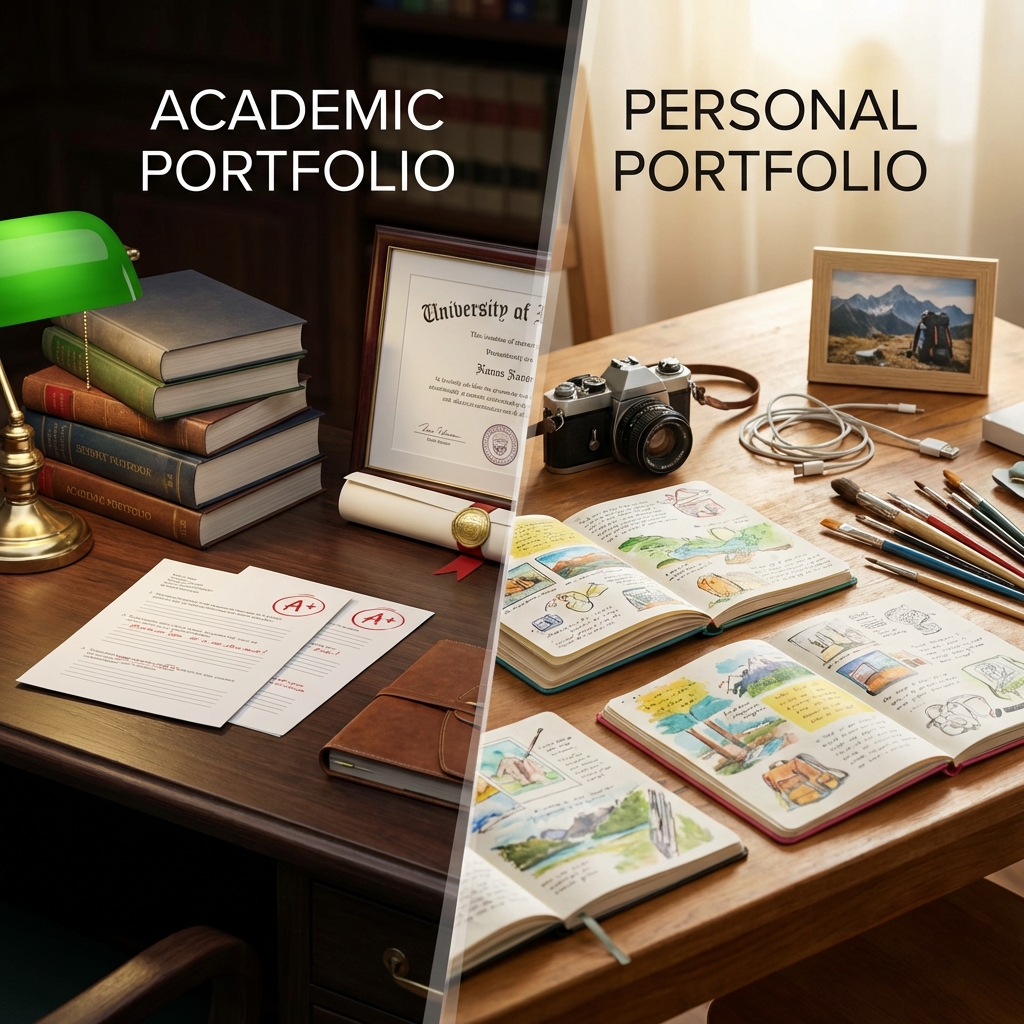
You have decided to build a portfolio. Great! But do you need an Academic Portfolio or a Personal Portfolio?
"Wait," you ask, "aren't they the same thing?"
Not quite. While they share many similarities (they both feature your name and your work), they serve fundamentally different purposes, target different audiences, and require different strategies to build. Confusing the two can lead to a portfolio that feels disjointed or fails to impress the person reading it.
In this guide, we will break down the key differences, explore case studies of each, and help you decide which one you need right now.
1. The Core Purpose
Academic Portfolio
Purpose: Assessment and Compliance.
An Academic Portfolio is typically strictly defined by a teacher, a school board, or a curriculum. Its goal is to prove that you have learned specific material. It is evidence of learning.
- The Question it Answers: "Did this student meet the learning objectives?"
- Example: A senior capstone portfolio where you must include one research paper, one creative project, and one reflection on community service.
Personal Portfolio
Purpose: Branding and Opportunity.
A Personal Portfolio (or Professional Portfolio) is defined by you. Its goal is to sell your skills and potential to the world. It is a marketing tool.
- The Question it Answers: "Whay should I hire/admit this person?"
- Example: A website you build to apply for internships, featuring your photography hobby, your coding side-project, and your volunteer leadership role.
2. The Audience
Academic Portfolio
Audience: A Captive Audience (Teachers/graders).
Your teacher has to read your portfolio to give you a grade. They will likely read every word because it is their job. You don't need to fight for their attention.
Personal Portfolio
Audience: A Skimming Audience (Admissions officers/Recruiters).
A recruiter spends an average of 6-10 seconds on a resume. They will scan your portfolio just as quickly. If they don't see something interesting in the first 5 seconds, they will click away. You must captivate them immediately.
3. Content Selection
Academic Portfolio
Selection Rule: Comprehensive / Prescriptive.
You often don't have a choice. You must include what is required, even if it's not your best work. If the rubric asks for a "Chemistry Lab Report," you must include it, even if you got a B- on it.
Personal Portfolio
Selection Rule: Curated / Strategic.
You have 100% control. If you are bad at Chemistry, you simply don't put Chemistry in your personal portfolio. You highlight your strengths (e.g., English, Art, Leadership) and hide your weaknesses.
4. Tone and Style
Academic Portfolio
Tone: Formal, Standardized, and Reflective.
It often adheres to strict formatting guidelines (APA/MLA style). Reflections are deep and focus on the learning process ("I grappled with the concept of stoichiometry...").
Personal Portfolio
Tone: Authentic, Unique, and Persuasive.
You want to show personality. You can use color, humor, and a unique voice. Reflections focus on results and impact ("I managed a team of 5 to raise $1,000...").
Case Studies: Seeing the Difference
Student A: Sarah (The Academic Portfolio)
Sarah is finishing AP English. Her teacher requires a portfolio.
- Content: Two analytical essays, one poem, and a reflection journal.
- Format: A Google Drive folder or a school LMS.
- Goal: To get an A in the class.
Student B: Sarah (The Personal Portfolio)
Sarah wants to study Journalism in college.
- Content: Her best analytical essay (from the academic portfolio), but also articles she wrote for the school newspaper, her photography Instagram feed, and a video of her interviewing the principal.
- Format: A Squarespace website with a cool logo.
- Goal: To get accepted into Columbia University.
Which One Do You Need?
Unless your teacher has specifically assigned an academic portfolio for a grade, you almost certainly need a Personal Portfolio.
A Personal Portfolio is the asset that travels with you. It helps you get into college, get scholarships, and land jobs. It is your professional identity.
The good news? You can often repurpose content from your Academic Portfolio for your Personal one. Take that A+ History paper (Academic), design a nice cover image for it, write a punchy summary, and upload it to your website (Personal). It’s about repackaging your hard work for a new audience.
Conclusion
Understand the rules of the game. If you are playing for a grade, follow the rubric (Academic). If you are playing for your future, follow your passion (Personal). The most successful students master both.