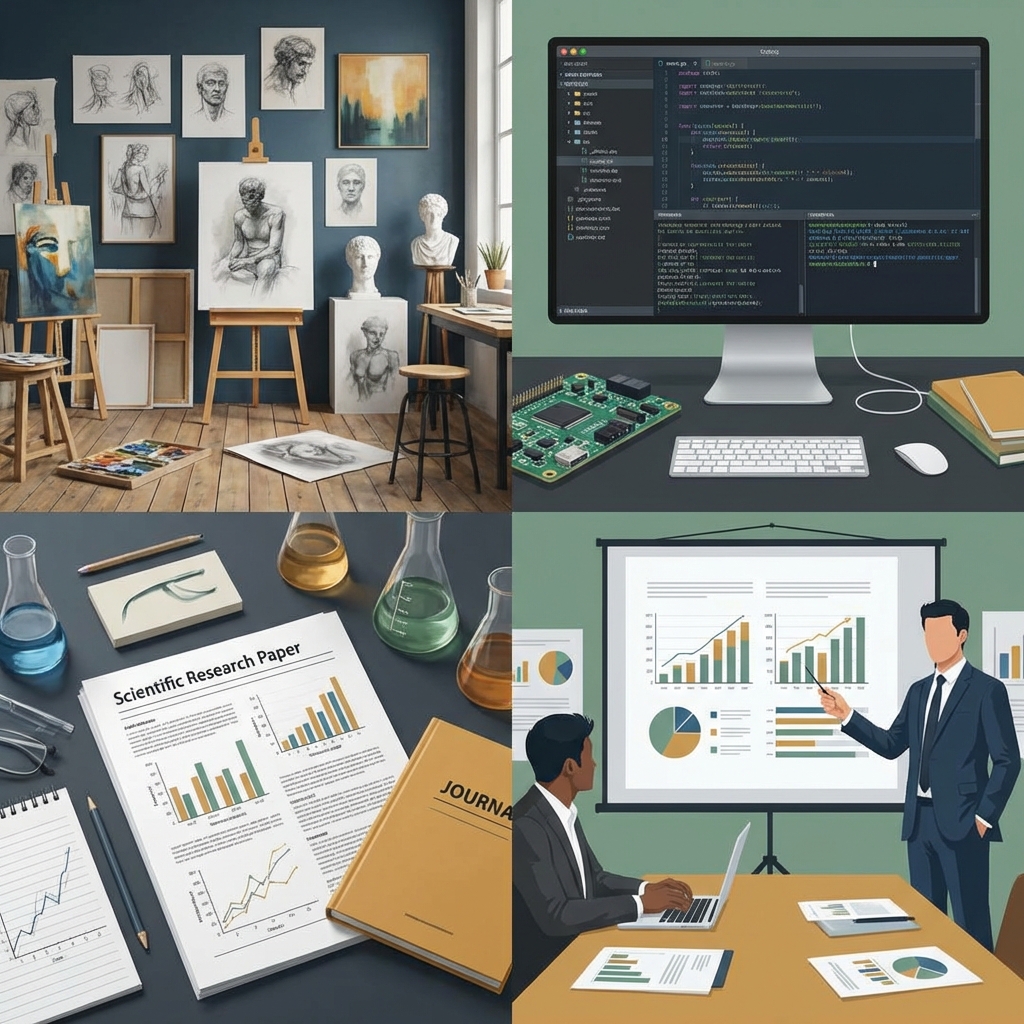
When you hear the word "portfolio," you probably imagine a collection of beautiful images. But in the world of education and career development, the term is much broader. Not all portfolios serve the same purpose.
Trying to build a "one-size-fits-all" portfolio is often a recipe for failure. A portfolio designed to get you into art school looks very different from one designed to pass a final exam. Understanding the different types of portfolios will help you choose the right format for your specific goals.
Broadly speaking, there are four main types of student portfolios: Showcase, Process, Assessment, and Hybrid. Let’s dive into each one.
1. The Showcase Portfolio (The "Best of the Best")
Goal: To show off your highest achievements to an external audience (colleges, employers, clients).
This is what most people think of when they hear "portfolio." It is highly curated. You are not showing your rough drafts, your mistakes, or your average work. You are showing the final, polished masterpieces.
Characteristics:
- Selection: Highly selective. Includes only 3-5 of your absolute best projects.
- Audience: External (admissions officers, HR managers).
- Tone: Professional, confident, and results-oriented.
Best For:
- Applying to colleges or universities.
- Job hunting or seeking internships.
- Freelancers looking for clients.
2. The Process Portfolio (The "Journey")
Goal: To document deeply how you learn and work, rather than just what you produced.
In a Process Portfolio, the "messy middle" is the point. It includes sketches, early drafts, failed experiments, and reflections on what went wrong. It values growth over perfection. It answers the question, "How did you get from A to B?"
Characteristics:
- Selection: Comprehensive. Includes multiple versions of a single project.
- Audience: Internal (yourself, mentors) or Educational (teachers).
- Tone: Reflective, analytical, and vulnerable.
Best For:
- Design and engineering students showing their workflow.
- Demonstrating "growth mindset" to mentors.
- Personal specialized learning journals.
Example: Instead of just showing the final code for an app, you show the initial wireframes, the bugs you encountered, and how you fixed them.
3. The Assessment Portfolio (The "Proof of Skill")
Goal: To prove that you have mastered specific learning standards or skills.
This is often a requirement for graduation or certification. The items in this portfolio are chosen not because they are "cool," but because they check a specific box. If the curriculum says you must "demonstrate ability to write a research paper," you include a research paper.
Characteristics:
- Selection: Criteria-based. Every item maps to a specific requirement.
- Audience: Evaluators, teachers, certification boards.
- Tone: Formal and evidence-based.
Best For:
- End-of-year school assessments.
- Teacher certification programs.
- Technical skill verification (e.g., "Prove you know Python").
4. The Hybrid Portfolio (The Modern Standard)
Goal: To combine the best elements of Showcase and Process.
This is becoming the most popular format for modern students. It features your best work (Showcase) but creates depth by including "Behind the Scenes" case studies for those top projects (Process). Ideally, it attracts employers with the flashy final product and then convinces them with the depth of your thinking.
Characteristics:
- Selection: Balanced. High-quality final work supported by process documentation.
- Audience: Broad (Employers who want to see how you think).
- Tone: Professional yet authentic.
Best For:
- Most high school and college students.
- UX/UI Designers, Architects, and Developers.
Which One Should You Build?
If you are confused, here is a simple flowchart:
- Are you applying for a job/college right now? Build a Showcase portfolio. Focus on results.
- Are you trying to track your own learning or get feedback from a mentor? Build a Process portfolio. Focus on reflection.
- Is this for a grade? Build an Assessment portfolio. Focus on the rubric.
- Do you want a long-term career asset? Build a Hybrid portfolio. Focus on your professional story.
Conclusion
Don't let the terminology scare you. At the end of the day, your portfolio is a tool for communication. Choose the type that communicates the right message to the right person. And remember, you can have more than one! Many students keep a private "Process Portfolio" on their hard drive and a public "Showcase Portfolio" on the web.